Professional manufacturer of full set heavy-duty commercial gym equipment over 23 years.  +86 13642520076
 ky004@ky868.com
Language
Professional manufacturer of full set heavy-duty commercial gym equipment over 23 years. +86 13642520076 ky004@ky868.com
Commercial treadmills are important aerobic equipment in gyms, high-end clubs, hotel fitness areas and other places. The quality of one of its core components, the running belt, directly affects the user experience, safety and service life of the equipment. Compared with home treadmills, commercial treadmills are used more frequently and have greater load-bearing strength. Therefore, how to judge and check the quality of the running belt is crucial during procurement and daily maintenance.
This article will systematically explain the following aspects: the importance of running belts, the material structure of running belts, key points of quality inspection, identification of common problems, purchasing recommendations, etc., to help gym operators, equipment purchasers and technical maintenance personnel correctly evaluate the quality of running belts and ensure the safe operation of fitness equipment.
1.The role of the running belt in commercial treadmills
The running belt is the part of the treadmill that comes into direct contact with the user's feet. It is laid between the roller and the running board of the treadmill and moves with the motor drive. Its main functions include:
Providing a stable and comfortable running surface
Absorbing impact and protecting joints
Ensuring smooth operation and avoiding slipping
Withstanding long-term, high-frequency pedaling and friction
A high-quality treadmill not only improves the user experience, but also extends the life of core components such as motors and rollers, reducing maintenance frequency and repair costs.
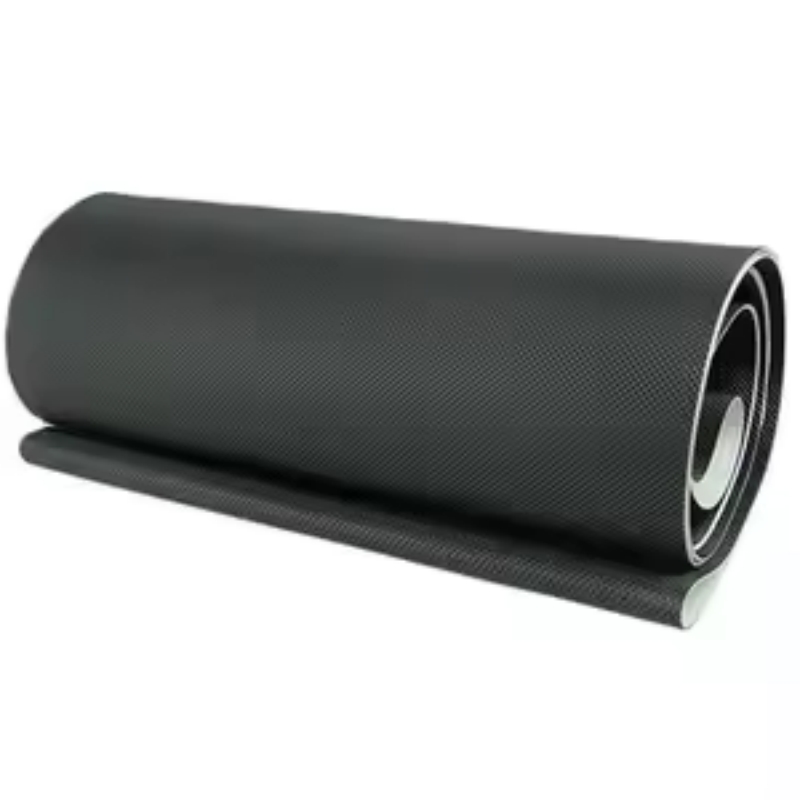
2.Material and structure of running belt
A high-quality commercial running belt usually consists of three or four layers:
Top layer (wear-resistant layer): Made of PVC or TPU, it has anti-slip and wear-resistant properties. The surface usually has patterns or textures to enhance friction.
Buffer layer: Located in the middle, it is generally made of foam or rubber material to absorb sports impact and improve comfort.
Strength layer (stretching layer): Made of high-strength polyester fiber or nylon fabric, it is the skeleton structure of the running belt and determines its tensile strength and stability.
Bottom layer (sliding layer): It is in direct contact with the running board and is usually made of lubricating materials such as polyester, which helps reduce friction and heat accumulation.
Different manufacturers and brands will have differences in material selection and thickness configuration, which directly affects the performance and price of the running belt.
3.Five key points to check the quality of commercial treadmill belts
A.Appearance and thickness inspection
Check whether the surface of the running belt is flat, without obvious scratches, cracks or delamination.
Observe whether the pattern is uniform and whether there is any slipping phenomenon.
Measure the thickness of the running belt: The thickness of the running belt of a general commercial treadmill is between 1.6mm and 3.0mm. If it is too thin, it will be easy to wear, and if it is too thick, it may increase energy consumption.
B.Flexibility and Rebound Test
A high-quality running belt should have good flexibility and rebound performance. You can manually fold a small section of the running belt to see if it is easy to break and whether there are obvious creases. High-quality materials have strong rebound and are not easy to deform.
C.Friction and anti-slip ability
When users are running, the running belt must have good anti-slip ability. You can simulate the running action by wearing shoes and stepping on the static running belt to feel whether there is slipping or instability. A high-quality running belt has moderate friction, which is neither slippery nor too rough.
D.Running sound and running smoothness
Start the treadmill and let the running belt run at low, medium and high speeds, and observe the following issues:
Is the running belt centered, with any deviation or slippage;
Is there any abnormal noise, such as "clicking" sound, metal friction sound;
Is the running feeling smooth and smooth, without shaking or jumping.
These conditions can reflect the running-in between the running belt and the running board and the tension structure of the running belt itself.
E.Heat resistance and durability test (suitable for pre-sale evaluation)
Run continuously for more than 1 hour at high intensity to check whether the running belt heats up too quickly, bubbles or deforms. High-quality running belts can withstand high-frequency friction for a long time, disperse heat quickly, and are not easy to deteriorate.
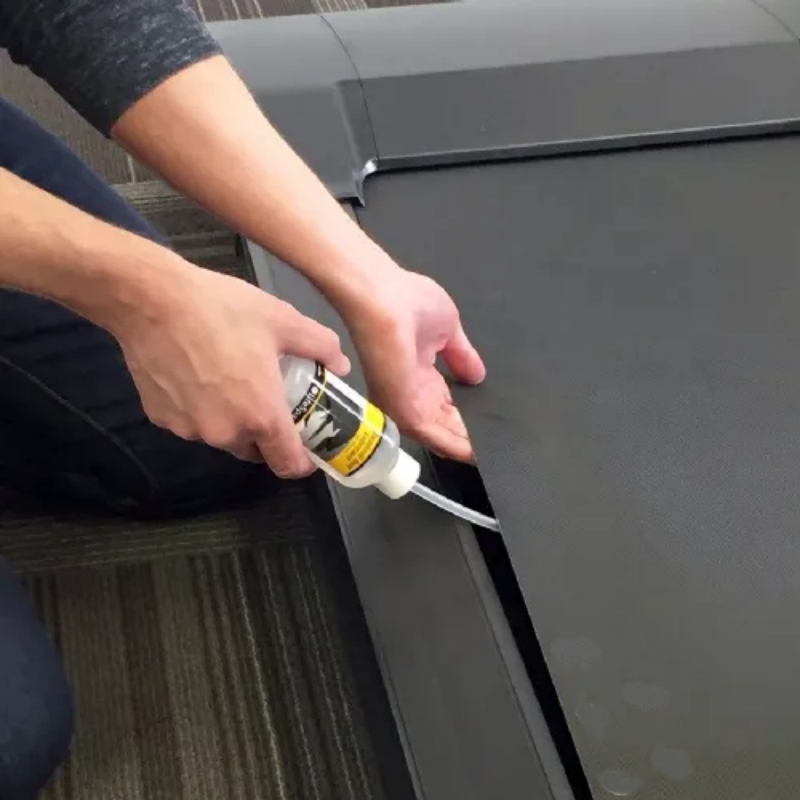
4.Common quality problems of running belts and identification methods
| Problem | Possible causes | Inspection method |
| Running belt slipping | Insufficient tension / material wear | Check tension and observe surface wear |
| Walking belt deviation | Improper adjustment screws / rollers out of sync | Check the tail tension screw and the centering of the running belt |
| Abnormal sound | Foreign matter stuck / material deterioration | Check the bottom layer and listen to the source of the sound |
| Surface peeling | Top material is of poor quality/used for too long | Observe the surface and press to see if it peels or flakes off |
5.Buying advice: How to choose a high-quality commercial treadmill?
Choose well-known brands or experienced manufacturers to avoid low-priced and low-quality products;
Give priority to four-layer running belts, which have better overall durability and comfort;
Choose the wear resistance level of the running belt according to the flow of gym customers. High-strength wear-resistant types should be selected for places with high daily traffic;
Pay attention to after-sales service: As a wearing part, whether the running belt is convenient to replace and whether it can be delivered quickly should also be confirmed before purchasing;
Sample testing: If conditions permit, the manufacturer can be asked to provide samples for running testing or experience.
Although the running belt is only a "surface" component of the treadmill, its quality directly affects the overall performance and service life of the equipment. When purchasing and inspecting commercial treadmills, the inspection and evaluation of the running belt cannot be ignored. Only by mastering the correct method and starting from multiple dimensions such as appearance, material, and running performance can the long-term stable operation of the treadmill be ensured, the safety experience of members can be guaranteed, and the professional level of fitness venues can be improved.

 +86 13642520076
 G10 Workshop, Longteng Industrial Zone, Shiling Village Committee, Longtang Town, Qingcheng District, Guangzhou, Guangdong, China
 ky004@ky868.com
 +86 13642520076